MicsPad turns your phone into a wireless keyboard, touchpad, mouse and keyboard-based game pad for a computer, tablet or TV. The free Android app from Google Play pairs as a real Bluetooth keyboard and mouse, so nothing is installed on the device you control. The Web Remote at micspad.micstec.com works in any phone browser, including on an iPhone. It sends your input over the internet to a small free helper on a Windows, macOS or Linux computer. The Android app can also act as a Web Remote. This guide covers both modes, every control, voice input, quick words, the full-screen pads, the game pad, helper setup and troubleshooting.
| Best for | Controlling a PC, Mac, Linux desktop, smart TV or tablet from the couch, presenting, typing on a device with no keyboard, and playing keyboard-controlled games from a phone |
| Bluetooth mode | MicsPad on Google Play (free, no ads). Needs Android 9 or later with Bluetooth HID device support. Works with anything that accepts a Bluetooth keyboard and mouse. Nothing to install on the device, and no internet needed |
| Web Remote mode | micspad.micstec.com in any phone browser, or Web Remote in the Android app, plus the free micspad_agent helper on the computer. Ready-made helpers are available for Windows x64 and Linux x64. macOS and Linux arm64 use a Python 3 install. Linux needs an X11 session |
| Account | None. The Web Remote uses a room key that you choose or that the Linux launcher creates |
| Languages | Android app: English and Simplified Chinese (switch in ⋮ → Language). Web Remote: English |
| Privacy | No analytics or ads in the Android app. Bluetooth input goes straight from the phone to the paired device. Web Remote input passes through the MicsPad relay, which forwards it without storing it. Anyone with your room key could send input while the helper runs |
Watch the overview
This 47-second Google Play promo video shows the touchpad, landscape keyboard, Bluetooth pairing, voice input, the full-screen pads and the game pad. You can also watch it on YouTube. The first 21 seconds are an animated demonstration. The later feature scenes use real Android screenshots, and the voice scene uses sample text.
Which mode should I use?
| If… | Use |
|---|---|
| You have an Android phone and the device is nearby | Bluetooth. No software is needed on the device, and it works with TVs and tablets |
| You have an iPhone, or your Android phone cannot act as a Bluetooth keyboard | Web Remote in the phone's browser |
| The computer has no Bluetooth, is in another room or is on another network | Web Remote. It works over the internet |
| You cannot install software on the computer | Bluetooth |
| You want to type Chinese, emoji or other non-keyboard characters | Web Remote. Bluetooth can only type characters from a standard US keyboard |
| You want to control several computers | Either. Bluetooth remembers each paired computer, and Web Remote lists every helper that uses your room key |
The touchpad, keys, shortcuts, text box, voice input, quick words, full keyboard, full-screen pads and game pad work the same way in both modes.
Requirements
| Item | Requirement |
|---|---|
| Android app | Android 9 (Pie) or later. Bluetooth mode also needs a phone whose Bluetooth supports the HID device role. Some manufacturers leave it out, and the app tells you if your phone lacks it |
| Device controlled over Bluetooth | Anything that accepts a Bluetooth keyboard and mouse: Windows, macOS, Linux, ChromeOS, Android tablets and many smart TVs |
| Web Remote phone | A current browser on any phone. Voice input appears only where the browser supports speech recognition |
| Web Remote computer | Windows x64 (ready-made .exe), Linux x64 (ready-made binary) or macOS / Linux arm64 (installer sets up Python 3). Run it in a desktop session where you are logged in. Linux must use X11, because Wayland blocks input injection. macOS needs Accessibility permission |
| Network | Bluetooth mode needs none. Web Remote needs internet on both the phone and the computer |
| Game pad over Web Remote | Helper version 1.2.0 or newer |
| Chinese or emoji typing on Linux | xclip or xsel on the computer. Without one, the helper falls back to typing key by key |
Get MicsPad
- Android app: MicsPad on Google Play (package
com.micstec.micspad). It is free, with no ads, accounts or in-app purchases. - Web Remote: open micspad.micstec.com in your phone's browser. You can install it to your home screen.
- Computer helper (
micspad_agent, Web Remote only): use the one-command Linux launcher or the installers for Windows, macOS and Linux. Every file is on the agent download page. - Privacy policy: micspad.micstec.com/privacy.html.
The Android main screen
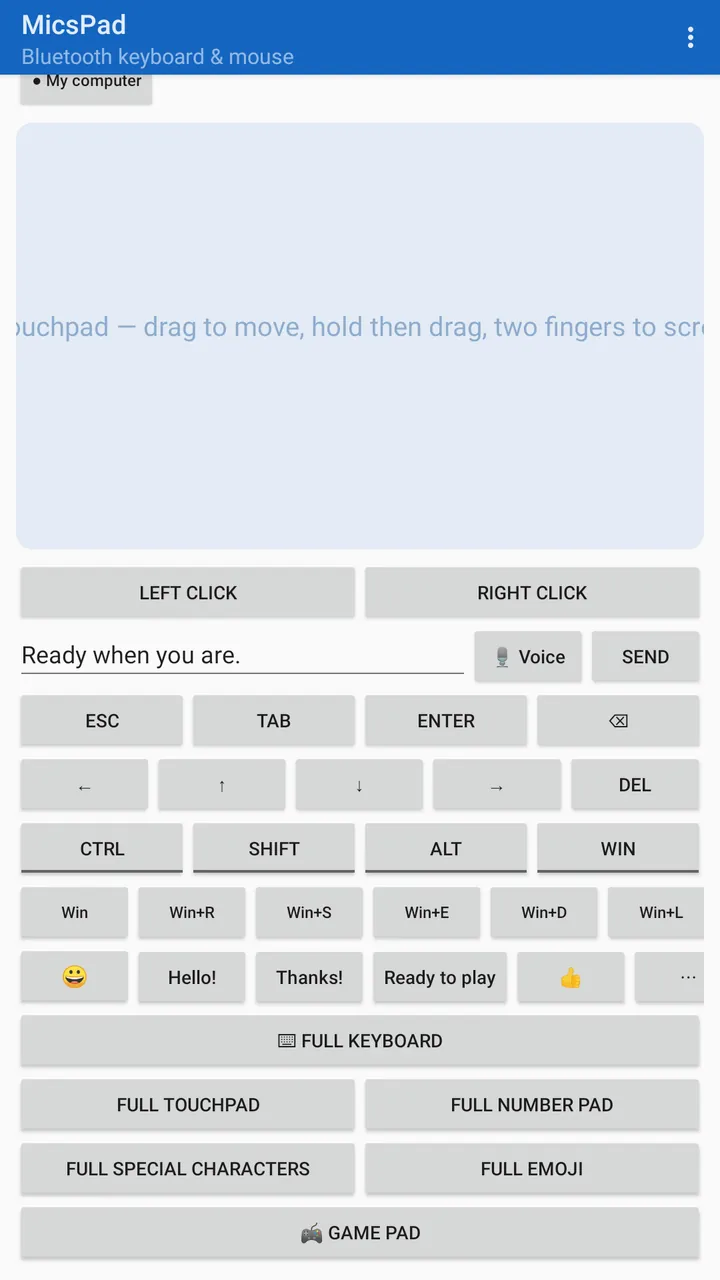
From top to bottom, the Android screen has these parts. The screen scrolls if it does not fit.
| Area | What it does |
|---|---|
| Status line | Shows the connection state, for example Registered — pair from the host, or pick a device or Connected to … |
| Bluetooth / Web Remote | Switches between the two modes. The active mode is fully opaque, and the app remembers your choice |
| Bluetooth: Register · Discoverable · Connect | Starts the keyboard role, makes the phone visible for pairing, or connects to an already-paired device. Register becomes Stop while it is active |
| Bluetooth: computer chips | Every computer you have connected to. ● marks the connected one |
| Web Remote: Room key (from the computer agent) · Connect | Enter the room key, then connect. Connect becomes Disconnect |
| Web Remote: computer chips | The helpers that are online for your room key. ● marks the one you are controlling |
| Touchpad | The large area: drag, tap and scroll. See Touchpad and mouse |
| Left click · Right click | Mouse buttons |
| Text box · 🎙 Voice · Send | Type or dictate text, then send it |
| Esc · Tab · Enter · ⌫ and ← ↑ ↓ → · Del | Single keys |
| Ctrl · Shift · Alt · Win | Modifiers that latch for the next key |
| Shortcut strip | One-tap key combinations. Swipe sideways for more |
| Quick words row | 😀, your most-used snippets, then ⋯ or More… |
| ⌨ Full keyboard | Landscape keyboard with a touchpad |
| Full touchpad · Full number pad · Full special characters · Full emoji · 🎮 Game pad | Full-screen modes |
The ⋮ menu has Full keyboard, Fullscreen modes, Help (the built-in user manual), Language and About. About shows the version, build number, build time and build ID.
Bluetooth mode
In this mode the phone itself becomes a Bluetooth keyboard and mouse, called MicsPad Keyboard/Mouse. Nothing is installed on the computer, and no internet connection is used.
Pair for the first time
- Install MicsPad from Google Play and open it. Tap Bluetooth at the top if it is not already selected.
- Tap Register. On Android 12 or later, allow the Nearby devices (Bluetooth) permission when asked. If you refuse it, the app shows Bluetooth permission denied — the app cannot work without it.
- Wait for the status Registered — pair from the host, or pick a device.
- Tap Discoverable and accept Android's prompt. The phone becomes visible for 120 seconds.
- On the computer, tablet or TV, open the Bluetooth settings, add a device and choose MicsPad Keyboard/Mouse.
- When the status says Connected to name, the touchpad and keys control that device. The device also appears as a chip under the Bluetooth buttons.
You can also pair from the phone's own Bluetooth settings first. Then tap Register, tap Connect, and pick the computer from Connect to paired device.
Reconnect, switch and forget computers
- Tap a chip to connect to that computer. If another computer is connected, MicsPad disconnects it first and the status shows Switching to …. Only one computer can be connected at a time. This is a Bluetooth keyboard limitation.
- Tap the active (●) chip to disconnect.
- Long-press a chip to forget it in MicsPad. The pairing is still kept on the computer and the phone.
- Automatic reconnect: when you return to MicsPad, it registers again and reconnects to the last computer, unless you tapped Stop.
- Stop ends the keyboard role and disconnects.
- While you are connected, the phone's screen stays on so that a screen timeout does not drop the link. The Google Play version has no background service, so keep MicsPad open while you use it.
Bluetooth status messages
| Status | Meaning |
|---|---|
| Idle — tap Register to begin | Nothing is running yet |
| Acquiring HID device profile… | Starting up |
| Registered — pair from the host, or pick a device | Ready to pair or connect |
| Connecting to … / Reconnecting to … / Switching to … | Connection in progress |
| Connected to … | Input goes to this device |
| Disconnected — ready to reconnect | The link dropped. Tap the chip, or let MicsPad reconnect |
| Host unplugged the virtual cable (unpaired) | The computer removed the pairing. Pair again |
| Bluetooth is off — enable it and retry | Turn Bluetooth on |
| Register first, then connect | Tap Register before Connect |
| This phone's Bluetooth stack has no HID device role / Registration rejected — HID device role unavailable / Registration revoked by the Bluetooth stack | This phone cannot act as a Bluetooth keyboard. No setting fixes it, so use Web Remote |
Bluetooth limits
- Text: Bluetooth sends US-keyboard key presses, so only standard keyboard characters can be typed: letters, digits, common punctuation and space. If you send Chinese, emoji or other characters, MicsPad shows Bluetooth can only type standard keyboard characters. For Chinese or emoji, use Web Remote mode. and skips them. Full emoji is disabled in this mode.
- Keyboard layout: if the computer uses a non-US layout, some symbols, and on some layouts some letters, may come out differently.
- Media keys: Mute, Vol- and Vol+ on the full keyboard use a separate media report. If you paired before MicsPad 1.9.0, remove the pairing and pair again for these keys to work.
Web Remote mode
In Web Remote mode the phone sends input to the MicsPad relay at micspad.micstec.com. The relay forwards it to a helper (micspad_agent) running on the computer, and the helper types and moves the pointer there. The phone and the helper find each other with a shared room key of at least 6 characters. No account is needed.
- Start the helper on the computer with a room key.
- Enter the same key on the phone and connect.
- Pick the computer, then use the controls.
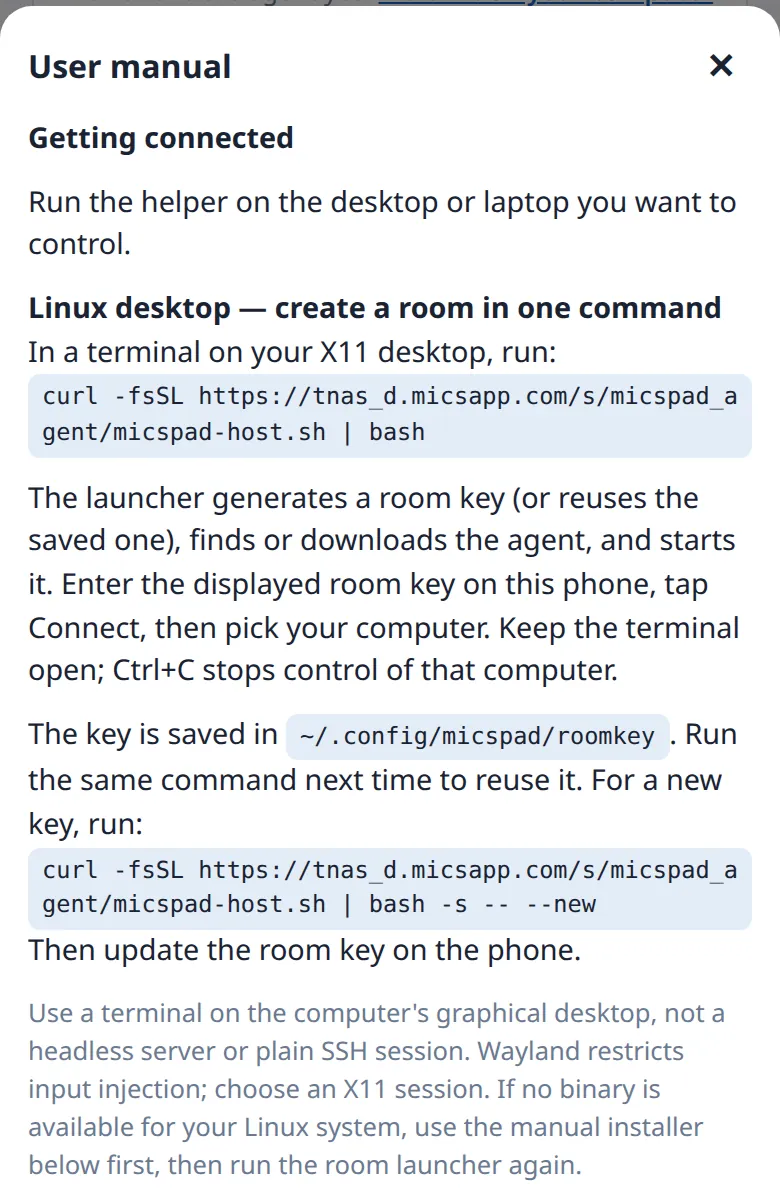
Linux: one-command room
On the Linux desktop you want to control, open a terminal in your graphical X11 session and run:
curl -fsSL https://tnas_d.micsapp.com/s/micspad_agent/micspad-host.sh | bashThe launcher does the following:
- Checks for a graphical session. It warns and asks before continuing over plain SSH or with no display. It warns that a Wayland-only session restricts input.
- Creates a room key, such as
abcd-efgh-jkmn(12 characters with no easily confused letters), and saves it to~/.config/micspad/roomkey. On later runs it reuses the saved key, so your phone's saved key keeps working. - Finds the helper in this order: an installed
micspad_agent, a local build, a fresh download of the Linux binary, then the Python source in a checkout. - Prints MicsPad host ready — room created, the room key, and the phone steps: open micspad.micstec.com or choose Web Remote in the Android app, enter the key, tap Connect, and pick the computer by name. If
qrencodeis installed, it also shows a QR code for the web app. - Starts the helper. Keep the terminal open, and press Ctrl+C to stop controlling this computer.
To pass options when piping from curl, add -s -- after bash. For example, this creates a new key:
curl -fsSL https://tnas_d.micsapp.com/s/micspad_agent/micspad-host.sh | bash -s -- --new| Launcher option | Effect |
|---|---|
--new |
Creates and saves a new room key. Enter the new key on your phone |
--key YOURKEY |
Uses your own key of at least 6 characters, and saves it for next time |
--name "Office Linux" |
Sets the computer name shown on the phone. The default is the hostname |
--install |
Installs micspad_agent permanently first, then starts the host |
--setup |
Installs the Python packages for the checkout's source fallback |
--server wss://…/ws |
Uses a different relay. The phone must use the same relay |
--help |
Shows the usage text |
If the launcher reports that no clipboard tool was found, install xclip, for example sudo apt install xclip. Without it, Chinese and emoji may not type correctly.
Windows, macOS and Linux: install the helper
Install once, then start the helper with a room key you choose each time.
Windows (PowerShell):
irm https://tnas_d.micsapp.com/s/micspad_agent/install.ps1 | iex
micspad_agent --key YOURKEY
The installer puts micspad_agent.exe in %LOCALAPPDATA%\micspad\bin and adds it to your user PATH, so open a new terminal before running it. You can instead download micspad_agent-win-x64.exe and run it from a terminal with --key YOURKEY. The helper does not start without a key.
macOS or Linux (Terminal):
curl -fsSL https://tnas_d.micsapp.com/s/micspad_agent/install.sh | bash
micspad_agent --key YOURKEY
The script downloads the ready-made binary where one exists (Linux x64). On macOS and Linux arm64 it creates a private Python 3 environment instead, so Python 3 must be installed. It installs to /usr/local/bin (or /opt/homebrew/bin on Apple Silicon Macs, using sudo if needed), otherwise to ~/.local/bin.
macOS permission: open System Settings → Privacy & Security → Accessibility and allow micspad_agent (or the Terminal you run it from). Without this permission, the pointer and keys do nothing.
| Installer option | Effect |
|---|---|
--user (bash) |
Installs to ~/.local/bin |
--prefix DIR (bash) |
Installs to a folder you choose |
--python (bash) / -Python (PowerShell) |
Skips the binary and uses the Python install |
--uninstall (bash) / -Uninstall (PowerShell) |
Removes the helper |
To use an option with the bash installer, run curl -fsSL https://tnas_d.micsapp.com/s/micspad_agent/install.sh | bash -s -- --user. For the PowerShell options, download install.ps1 first, then run .\install.ps1 -Uninstall.
Helper command-line options
| Option | Meaning |
|---|---|
--key KEY |
Room key shared with the phone. Required, at least 6 characters |
--name NAME |
Name shown on the phone. The default is the computer's hostname |
--server URL |
Relay address. The default is wss://micspad.micstec.com/ws |
--version |
Prints the version, for example micspad_agent 1.2.0 |
-h, --help |
Shows the options |
While it runs, the helper prints lines such as [info] connected to wss://micspad.micstec.com/ws as agent 'Office-PC' and [info] registered (id …). If the connection drops, it prints [info] reconnecting in 2s…, retrying with waits that grow to 30 seconds. Press Ctrl+C to stop it. The helper releases any keys the game pad is holding when it disconnects.
Connect your phone
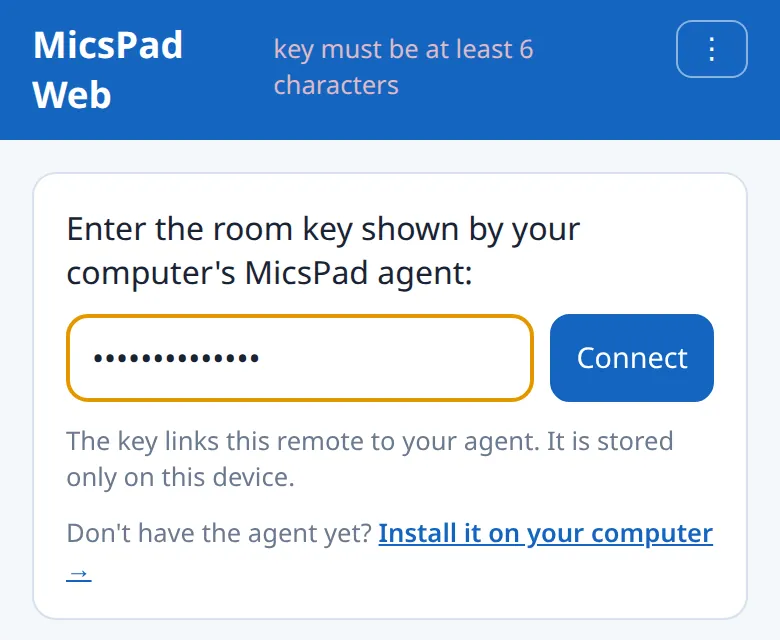
In a browser (any phone, including iPhone):
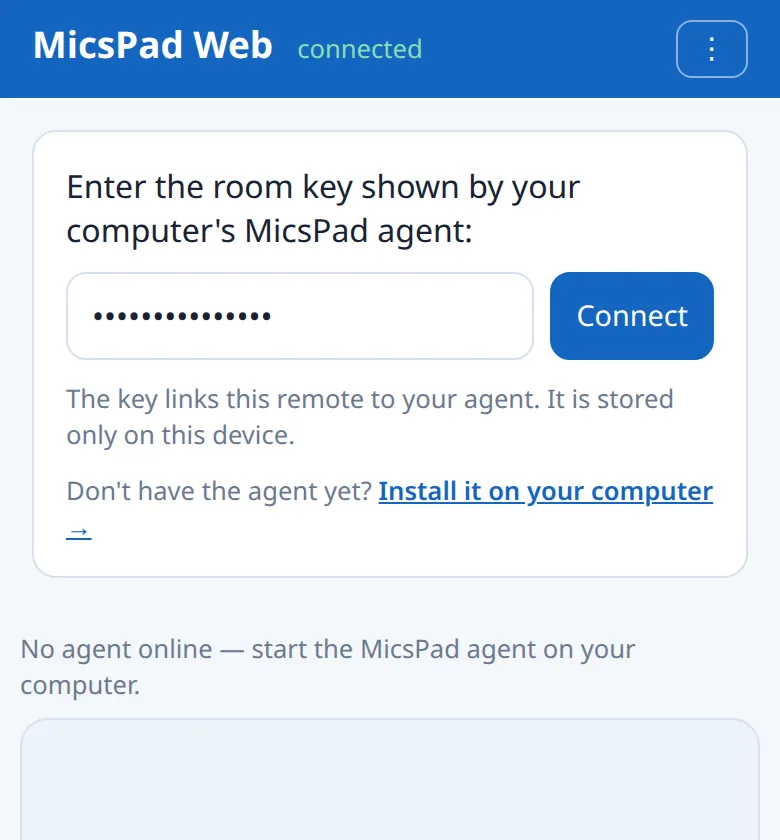
- Open micspad.micstec.com.
- In Enter the room key shown by your computer's MicsPad agent, type the key and tap Connect. The header status changes from connecting… to connected.
- The key is saved in this browser only. Next time, the page reconnects automatically.
In the Android app:
- Tap Web Remote at the top.
- Type the key in Room key (from the computer agent) and tap Connect. The status shows Connected — pick an agent.
- The app remembers the key and reconnects when you return to it, unless you tapped Disconnect.
Choose a computer
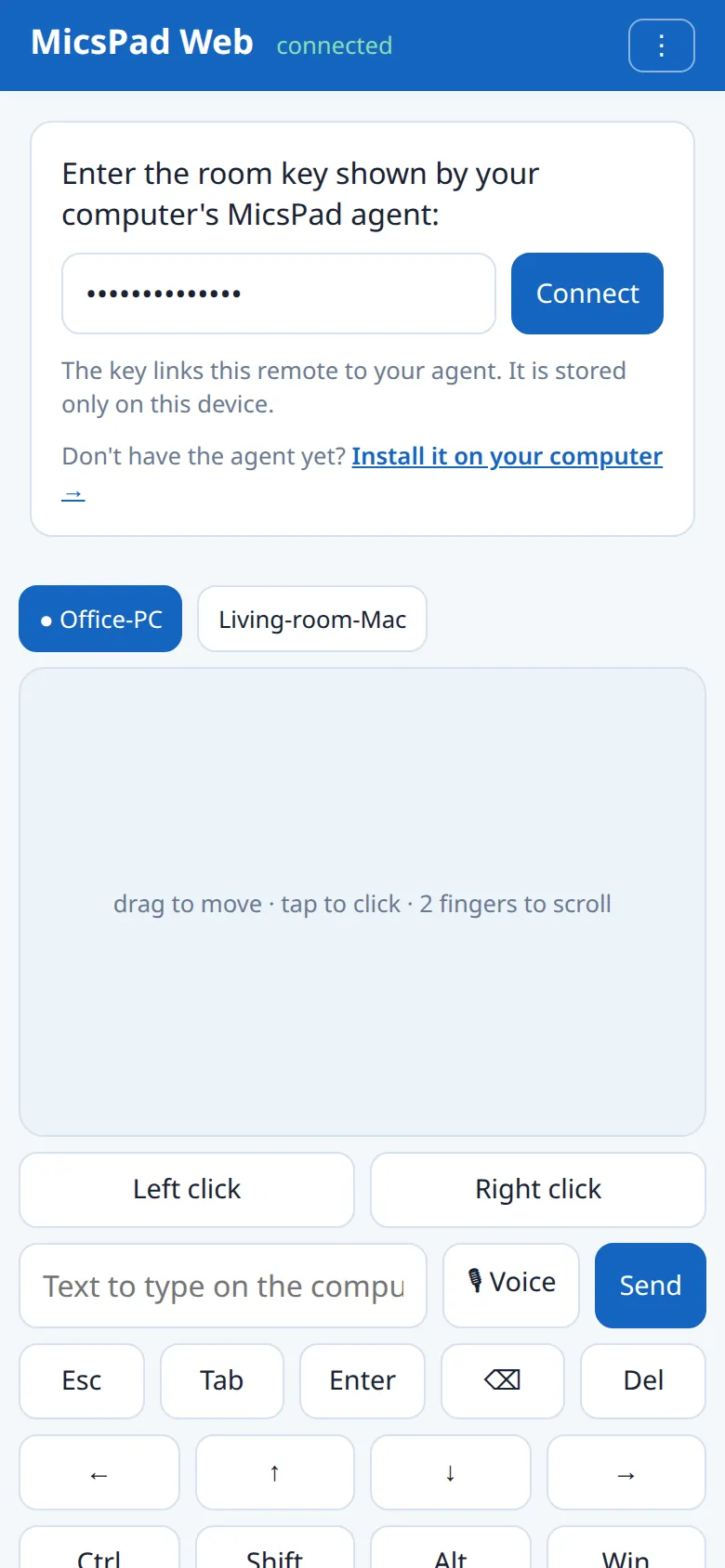
Each helper that uses your room key appears as a chip above the touchpad. The first one is selected automatically, and a ● marks the selected one. Tap another chip to send your input there instead. If you see No agent online — start the MicsPad agent on your computer, the helper is not running with that exact key.
You can run helpers on several computers with the same key and switch between them, and several phones can join the same room. Tap Disconnect to leave. In the browser, the room-key box stays visible above the controls.
How text reaches the computer
The helper types plain ASCII text directly. For other text, such as Chinese, accented letters or emoji, it places the text on the clipboard, presses Ctrl+V (⌘V on a Mac), then restores your previous clipboard. This works whatever keyboard layout or input method the computer uses. Each message is limited to 16 KB, so send very long text in parts.
Touchpad and mouse
| Gesture or control | Action |
|---|---|
| Drag one finger | Move the pointer |
| Tap | Left click |
| Tap with two fingers | Right click |
| Drag two fingers up or down | Scroll |
| Hold one finger still, then drag | Hold the left button: drag and drop, or select text. Lift your finger to release. This works on every Android touchpad and on the web's full-screen touchpads, but not on the web's main-screen touchpad |
| Left click / Right click | Click without tapping the pad |
The hold takes about 0.4 seconds on Android and 0.45 seconds on the web. The pointer speed is fixed. For a bigger pad, open Full touchpad. See Full-screen modes.
Keys, modifiers and shortcuts
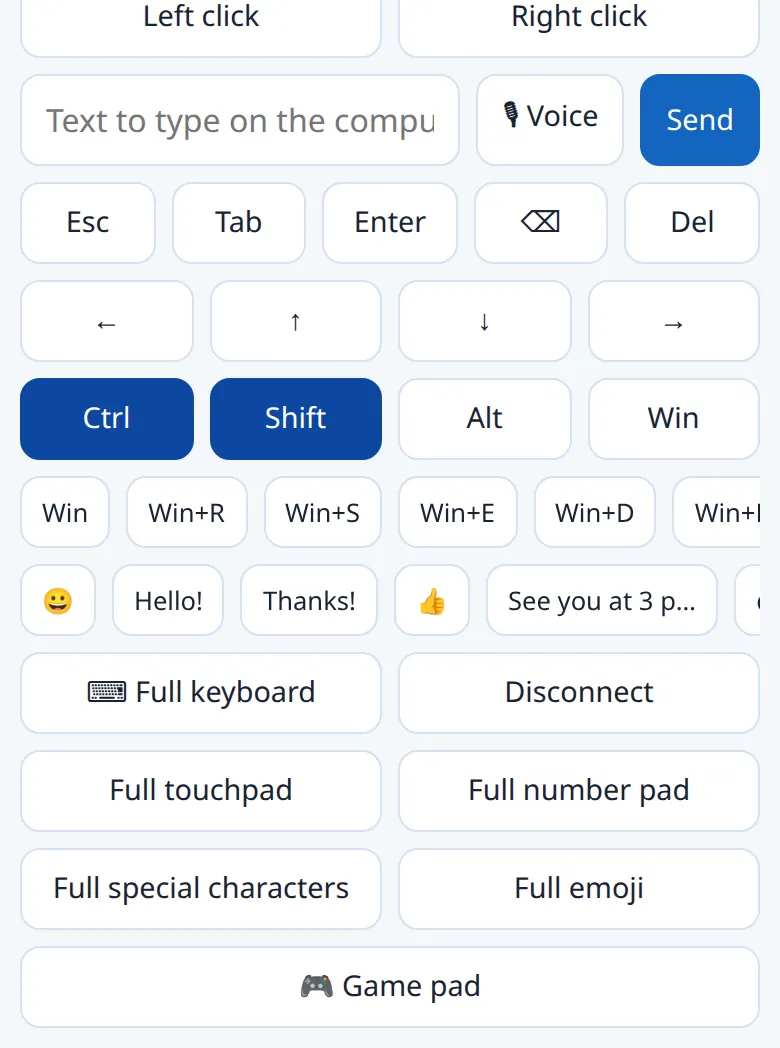
- Single keys: Esc, Tab, Enter, ⌫ (Backspace), Del and the arrow keys ← ↑ ↓ →.
- Modifiers: Ctrl, Shift, Alt and Win latch. Tap one or more so they light up, then tap a key. For example, Ctrl, Shift then ← selects the previous word. The modifiers release after that key. Tap a lit modifier again to cancel it. Win is the Windows key: Command (⌘) on a Mac and Super on Linux.
- Shortcut strip: one tap sends the whole combination. Swipe the strip sideways to see all of them.
| Shortcut | Typical use on Windows |
|---|---|
| Win | Open the Start menu |
| Win+R · Win+S · Win+E | Run box · Search · File Explorer |
| Win+D · Win+L | Show the desktop · Lock the computer |
| Alt+Tab · Alt+F4 | Switch windows · Close the window |
| Ctrl+Alt+Del | Security screen. Windows normally ignores it when software sends it, so it may do nothing over Web Remote |
| Ctrl+C · Ctrl+V · Ctrl+X · Ctrl+Z · Ctrl+A | Copy · Paste · Cut · Undo · Select all |
On a Mac, the Win combinations arrive as ⌘ combinations, and the Ctrl shortcuts are sent as Ctrl, not ⌘. For Mac copy and paste, latch Win and use the full keyboard.
Type text
- Tap the text box (Text to type on the host in the app, Text to type on the computer on the web) and type with the phone's keyboard.
- Tap Send, or press Enter or Send on the phone's keyboard. The text is typed at the computer's cursor, and the box clears.
Nothing is sent while you type, so you can correct the text first. To press Enter on the computer after the text, tap Enter in the key row.
Voice input
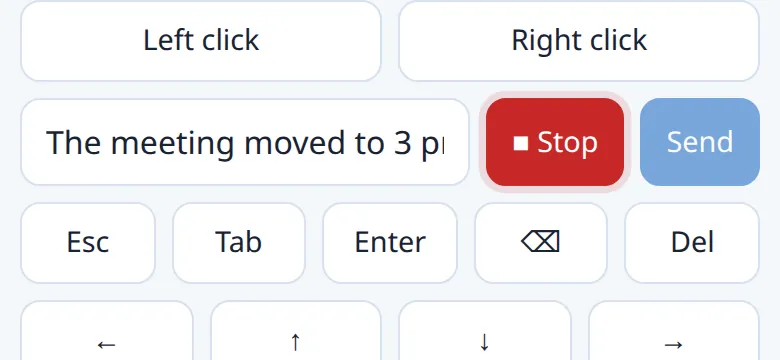
- Tap 🎙 Voice next to the text box. The first time, the Android app asks for the microphone permission.
- Speak. You can say several phrases. The words appear in the text box as you talk, at the cursor or replacing any selected text.
- Tap ■ Stop. The button shows … Processing (app) or ■ Stop · Processing… (web) for a moment.
- Check and edit the text, then tap Send. Dictated text is never sent until you tap Send.
| Detail | Behaviour |
|---|---|
| Speech service | Android uses the phone's speech-recognition service, and uses on-device recognition when available. The web uses the browser's speech service. Depending on the provider, audio may be processed online. MicsPad never sends audio through its relay |
| Language | The app's language on Android, the browser's language on the web |
| Web availability | 🎙 Voice appears only in browsers with speech recognition. Otherwise, use the dictation key on your phone's keyboard |
| Stops automatically | When you leave the app or page, switch modes, open a full-screen mode, or disconnect |
| Messages | Microphone permission is required for voice input. · Voice input is unavailable on this device. · Voice recognition could not reach its service. · Voice recognition is unavailable for this language. · Voice recognition failed. Try again. |
Quick words and emoji
The row above the shortcut keys holds 😀, up to six of your most-used snippets, and ⋯. When you have more than six, the last button is More…. Tap a snippet to type it on the computer at once. Each use counts towards its place in the row. Long snippets are shortened on their buttons, and snippets made only of spaces show as ␣.
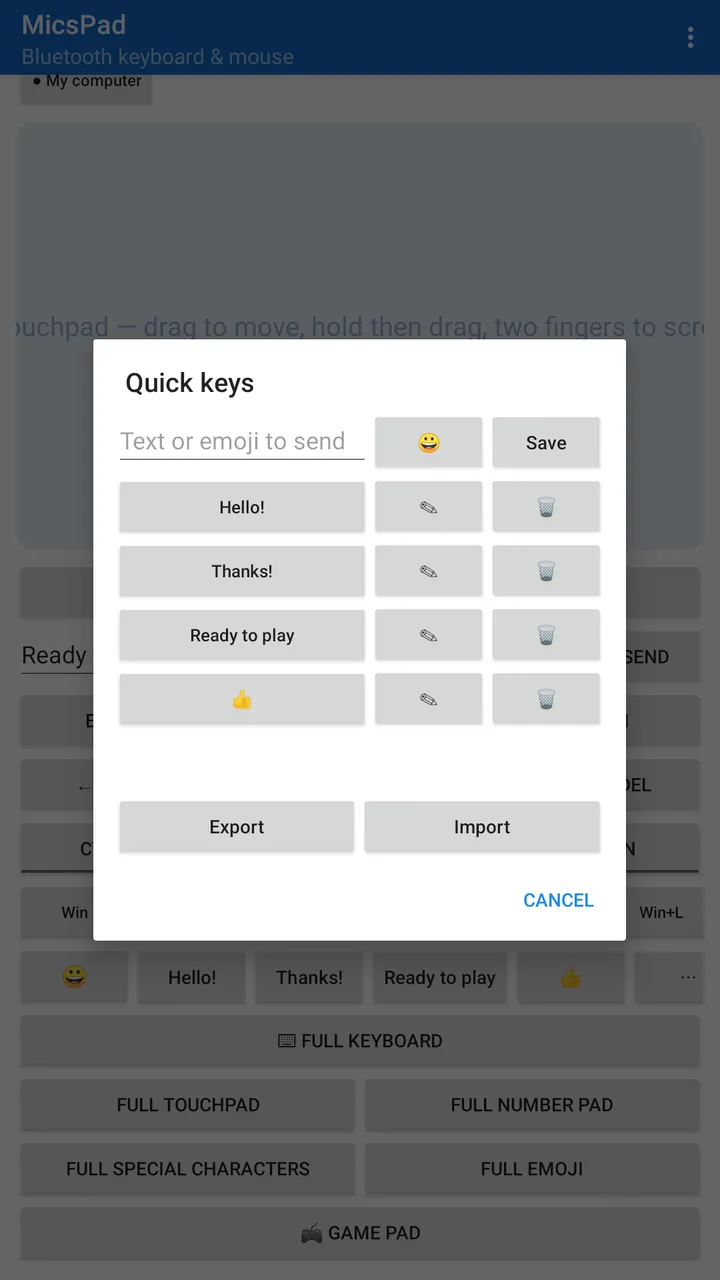
Manage quick keys: tap ⋯ or More… to open Quick keys.
- Add: type text or emoji in Text or emoji to send and tap Save. Any text works, including a single character, a space or an email signature.
- Insert emoji: tap 😀 in the manager to add an emoji at the cursor.
- Send: tap a snippet in the list.
- Edit: tap ✎, change the text, and tap Update. The web title changes to Edit quick key.
- Delete: tap 🗑.
- Export saves all snippets as
micspad-quick-keys.json, a JSON list of text strings. Android lets you choose where to save it, and the browser downloads it. - Import adds the snippets from such a file and skips any you already have. The app confirms with Imported N quick key(s). A file that is not a JSON list is rejected with Import failed. Use Export and Import to copy snippets between the app and the web, or between phones.
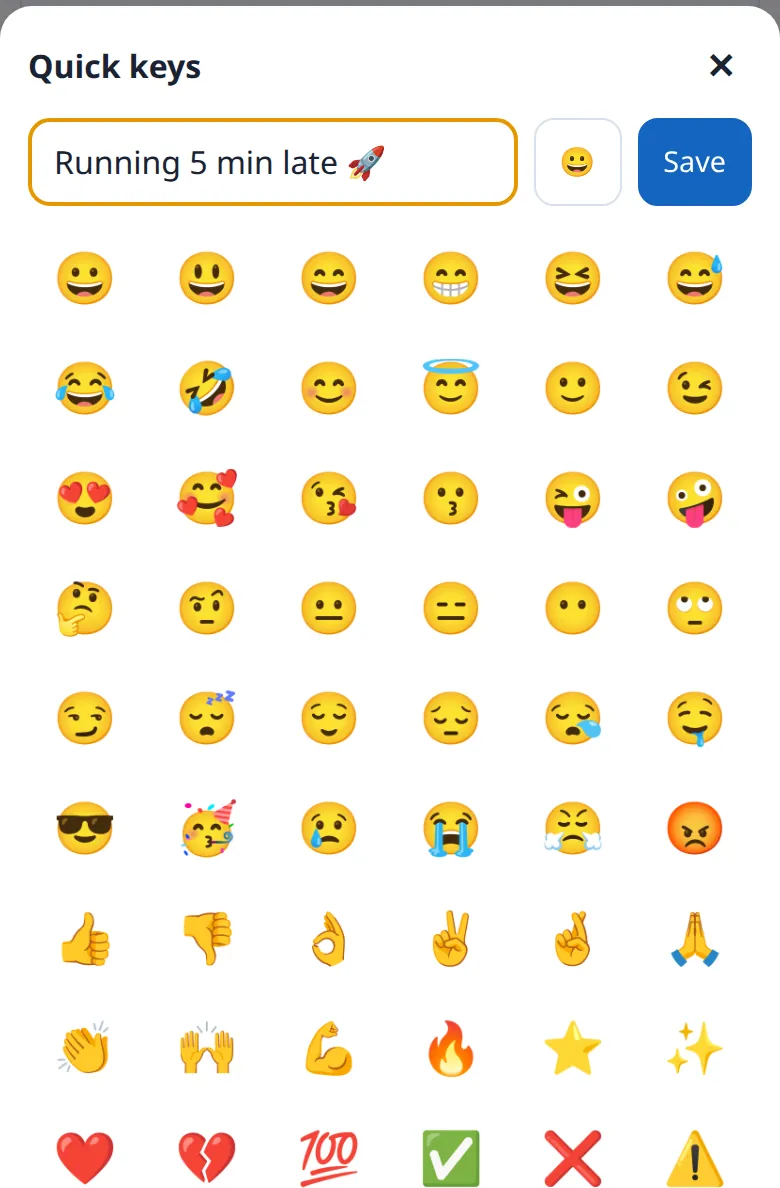
Snippets are stored on the phone. The app and each browser keep separate lists. In Bluetooth mode, only standard keyboard characters can be sent. See Bluetooth limits.
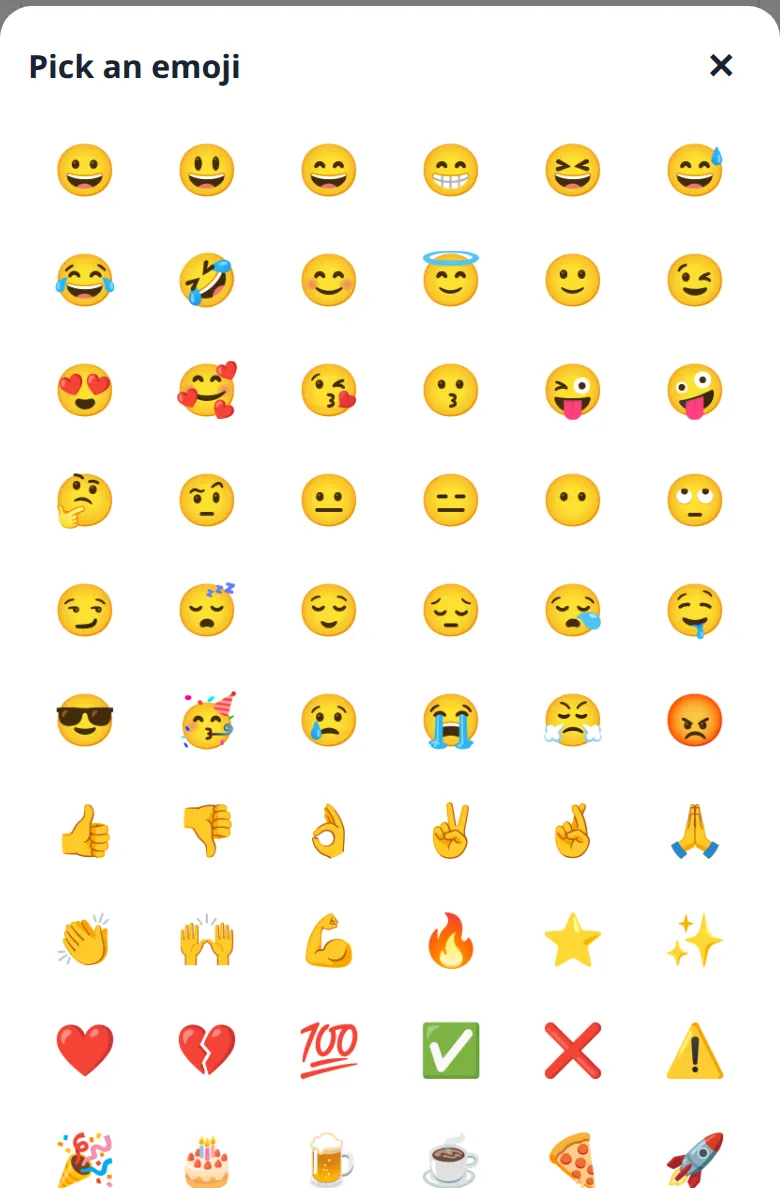
Emoji: tap 😀 in the quick words row to open Pick an emoji, which has 60 common emoji. Tap one to type it on the computer. For repeated emoji, use Full emoji. Emoji need Web Remote.
Full keyboard
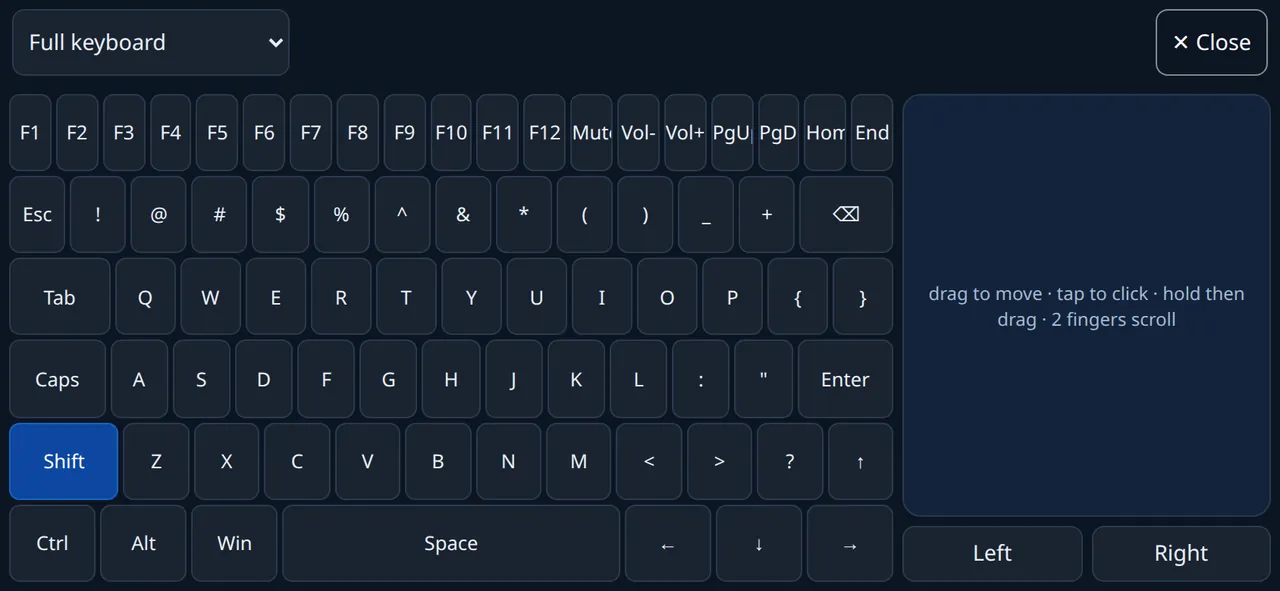
Tap ⌨ Full keyboard, or choose ⋮ → Full keyboard in the app. The screen turns to landscape and shows a full keyboard with a touchpad beside it.
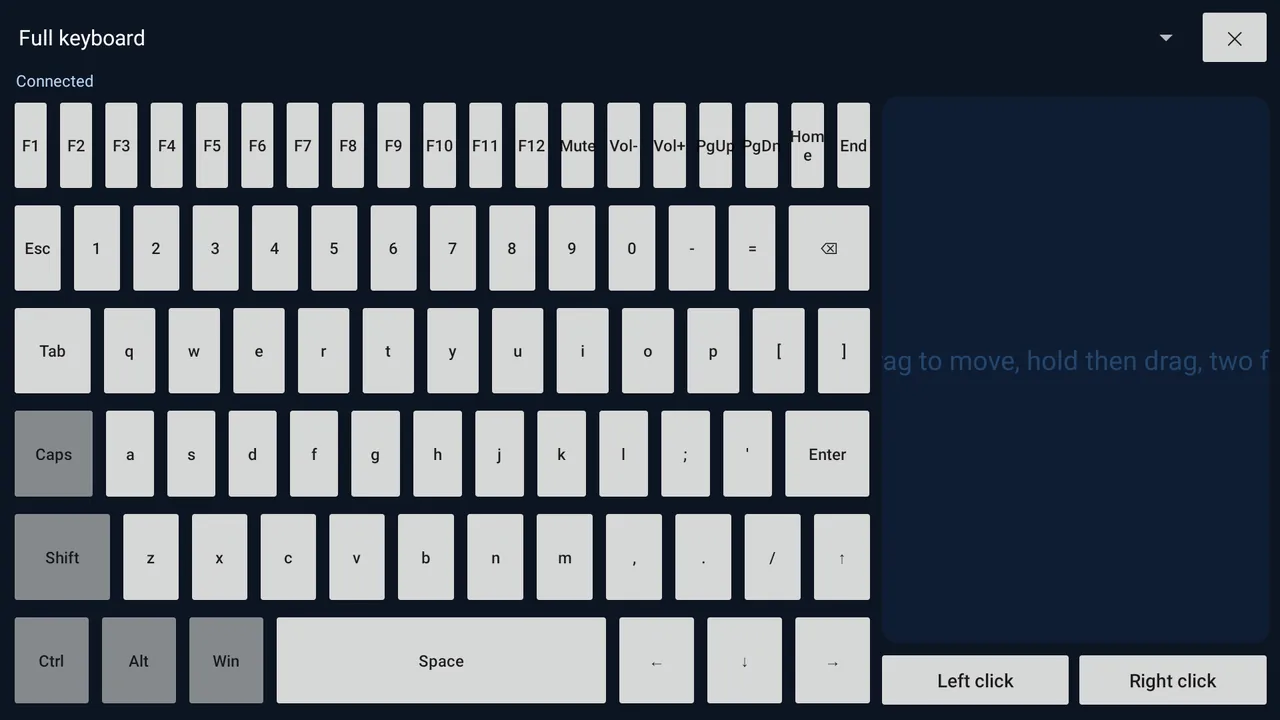
| Row | Keys |
|---|---|
| Function and media | F1–F12, Mute, Vol-, Vol+, PgUp, PgDn, Home, End |
| Numbers | Esc, 1–0, -, =, ⌫ |
| Letters | Tab Q–P [ ] · Caps A–L ; ' Enter · Shift Z–M , . / ↑ |
| Bottom | Ctrl, Alt, Win, Space, ← ↓ → |
- Shift applies to the next key only. While it is on, the labels change to show what you will type: capitals and ! @ # $ % ^ & * ( ) _ + { } : " < > ?.
- Caps stays on until you tap it again. With Caps on, Shift types lowercase letters.
- Ctrl, Alt and Win apply to the next key, so Ctrl then s sends Ctrl+S. You can combine them.
- The touchpad on the right works like the main one, including hold then drag, and has Left and Right click buttons.
- Use the selector at the top to switch to another full-screen mode, and ✕ (✕ Close on the web) to return.
Full-screen modes
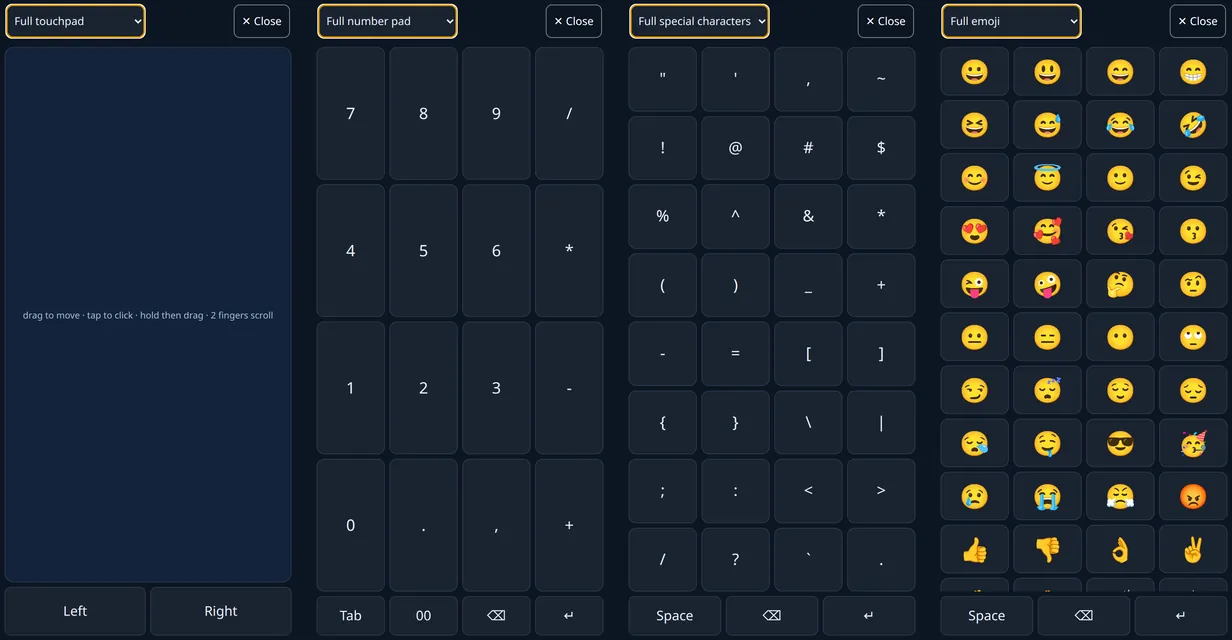
Open a mode with Full touchpad, Full number pad, Full special characters, Full emoji or 🎮 Game pad below the main controls. In the app you can also use ⋮ → Fullscreen modes. In a full-screen mode, the selector at the top switches between Full keyboard, Full touchpad, Full number pad, Full special characters, Full emoji and Game pad without reconnecting. ✕ returns to the main screen.
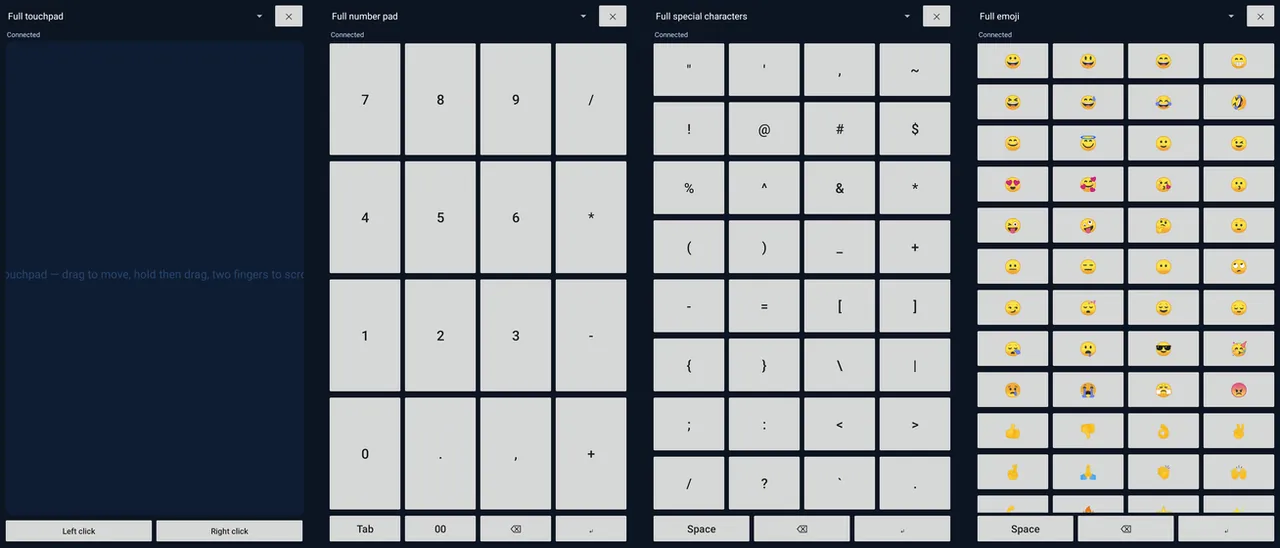
| Mode | What you get |
|---|---|
| Full touchpad | A pad that fills the screen, with Left click and Right click. All gestures work, including hold then drag |
| Full number pad | 7 8 9 /, 4 5 6 *, 1 2 3 -, 0 . , +, and the edit row Tab, 00, ⌫, ↵ (Enter) |
| Full special characters | All 32 punctuation symbols on a US keyboard, such as ! @ # $ % & * ( ) [ ] { } < > / ? ~ and quotes, plus Space, ⌫, ↵ |
| Full emoji | The 60 emoji as large buttons, plus Space, ⌫, ↵. Emoji are kept intact, including multi-part ones such as ❤️. Disabled in Bluetooth mode |
| Game pad | See Game pad |
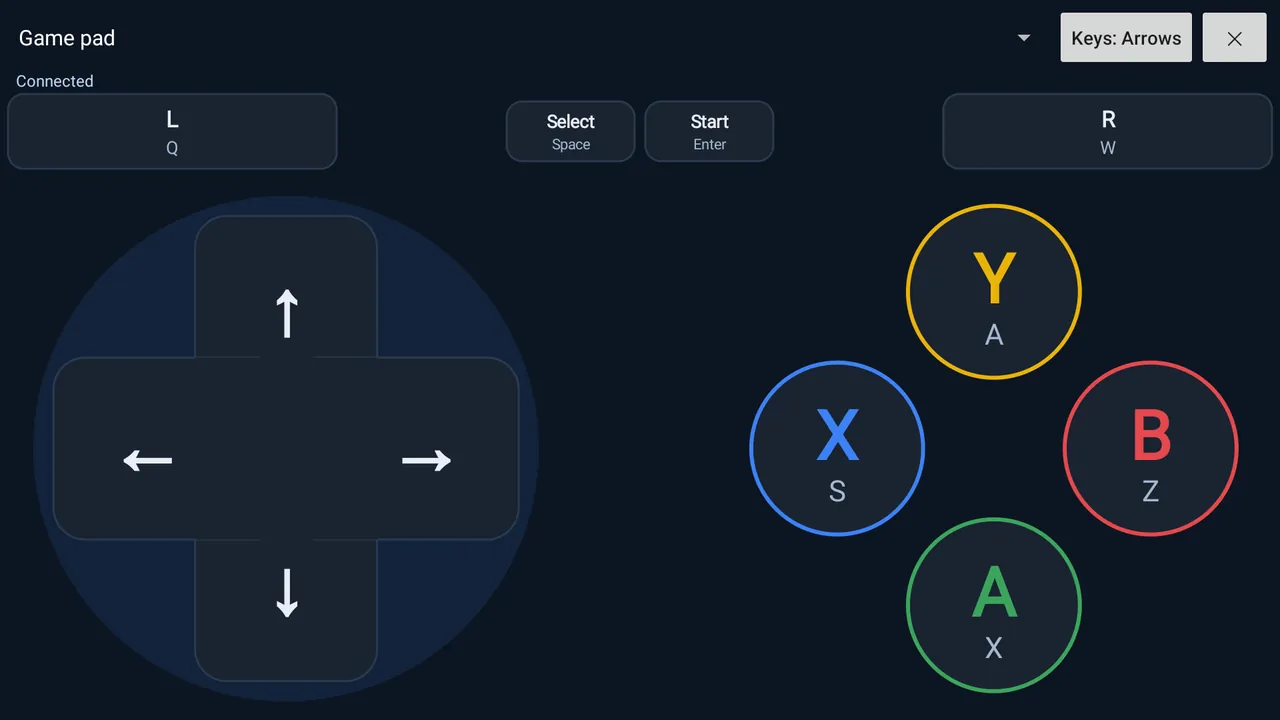
Every tap is sent immediately, and the pad stays open for repeated input. The full keyboard and game pad use landscape. The other pads work in portrait or landscape, and the special-character and emoji pads use eight columns in landscape. In the app, a line under the selector shows Connected or Not connected — connect on the main screen. The web version opens these modes full screen where the browser allows it.
Game pad
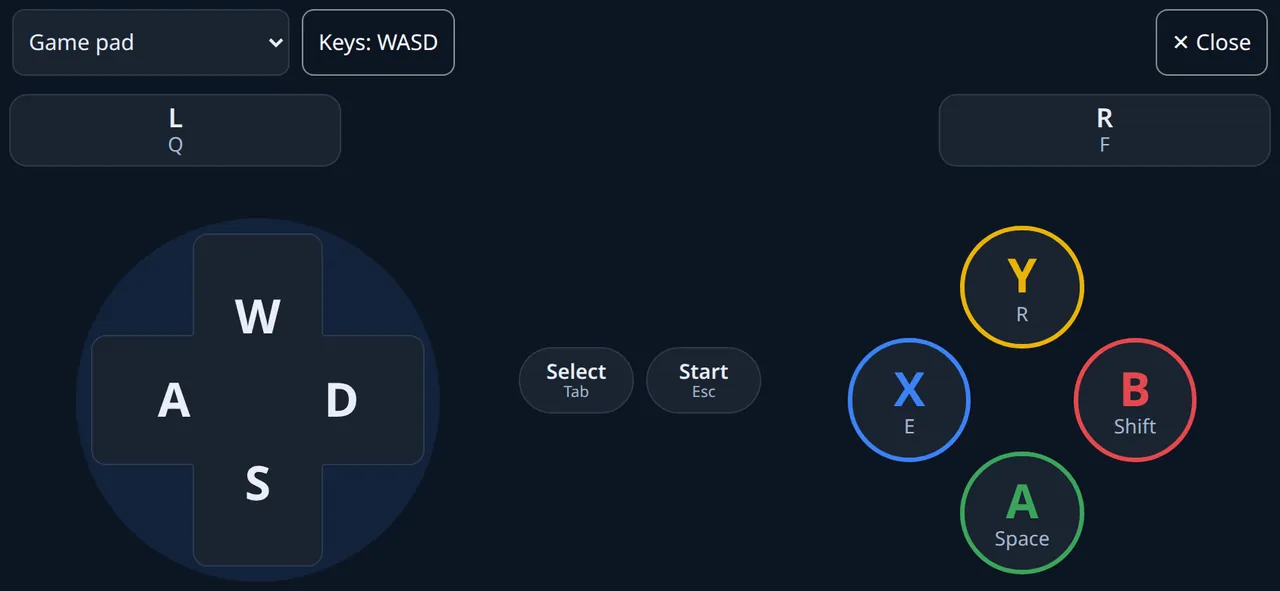
Tap 🎮 Game pad. The screen turns to landscape and shows a D-pad, A, B, X and Y buttons, L and R shoulder buttons, and Select and Start. Each control holds a keyboard key for as long as you touch it. It works with any game or emulator that has keyboard controls. It does not appear to the computer as a game controller.
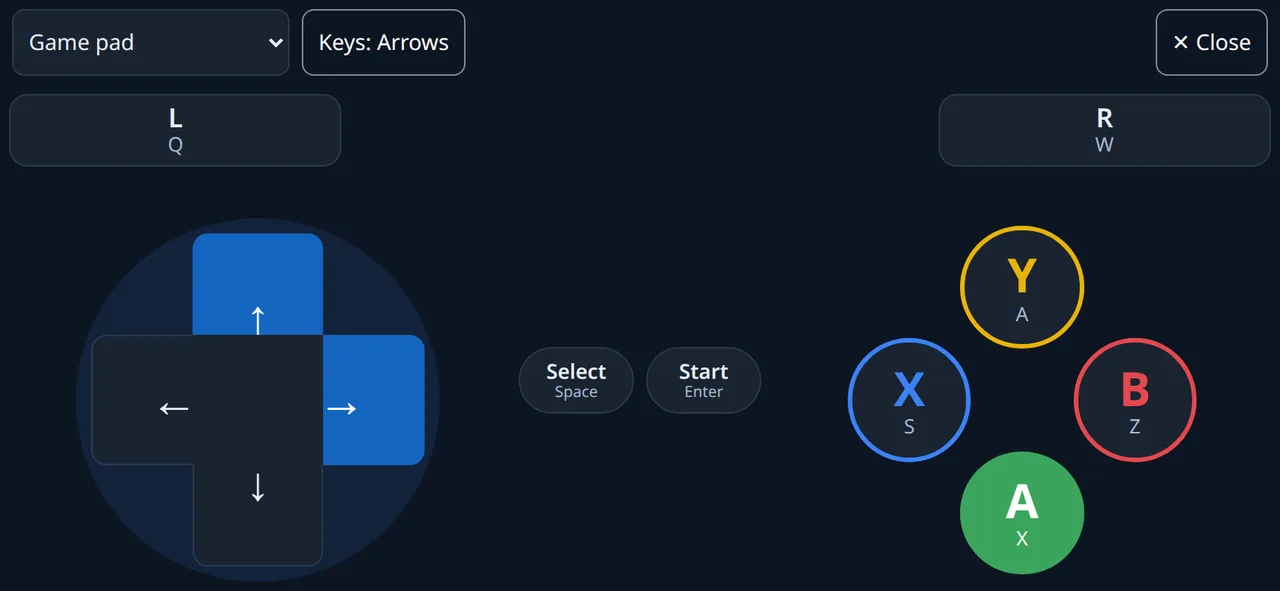
| Control | Keys: Arrows (emulators, browser games) | Keys: WASD (PC games) |
|---|---|---|
| D-pad up / down / left / right | ↑ / ↓ / ← / → | W / S / A / D |
| A | X | Space |
| B | Z | Shift |
| X | S | E |
| Y | A | R |
| L / R | Q / W | Q / F |
| Select | Space | Tab |
| Start | Enter | Esc |
The Arrows preset follows RetroArch's default keyboard controls for A, B, X, Y, L, R and Start.
- Change preset: tap Keys: Arrows or Keys: WASD at the top. MicsPad releases any held keys first and remembers your choice.
- Several fingers: hold a direction and press buttons at the same time.
- Diagonals: touch between two arms of the D-pad to hold both directions, and roll your thumb to change direction. A finger that starts on the D-pad stays on it until you lift it, even if it slides past the edge.
- Slide between buttons without lifting your finger.
- Feedback: pressed controls turn blue, and the phone gives a short vibration where supported.
- Safety: leaving the game pad, switching apps or turning off the screen releases every key. Over Web Remote, the phone repeats each held key about once a second. The helper releases any key it has not heard about for 3 seconds, so a dropped phone cannot leave a key stuck.
- Web Remote needs helper 1.2.0 or newer. Older helpers ignore game pad presses. Check with
micspad_agent --version.
Install the Web Remote as an app
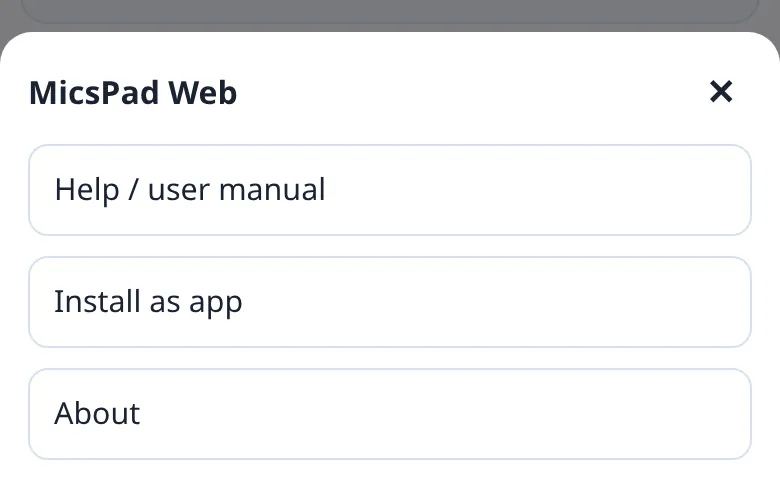
- Android (Chrome): tap Install in the header when it appears, or ⋮ → Install as app. If the browser has not offered installation, MicsPad tells you to use the browser menu's Install app or Add to Home Screen.
- iPhone or iPad (Safari): tap Share (□↑), then Add to Home Screen. ⋮ → Install as app shows the same steps.
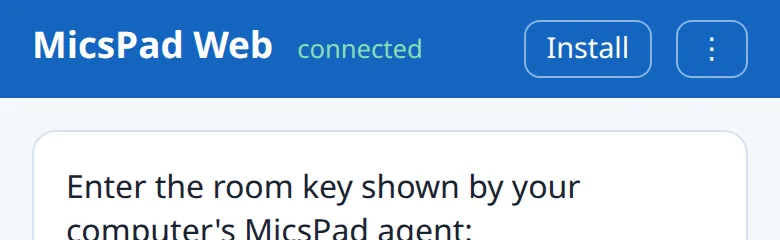
The installed app opens as MicsPad Web in its own portrait window, without the browser bar. It opens even when you are offline, but controlling a computer needs a connection. The page follows the phone's dark or light setting.
Settings, languages and help
MicsPad has no separate settings screen. It remembers these choices on the phone:
| Remembered | Where |
|---|---|
| Bluetooth or Web Remote mode, room key, connected computers, last computer | App |
| Room key | Browser, for this site only. It is cleared if you clear site data |
| Quick words and their use counts | App and each browser separately. Use Export and Import to move them |
| Game pad preset (Arrows or WASD) | App and browser |
| Language | App: ⋮ → Language offers System default, English and 中文(简体). |
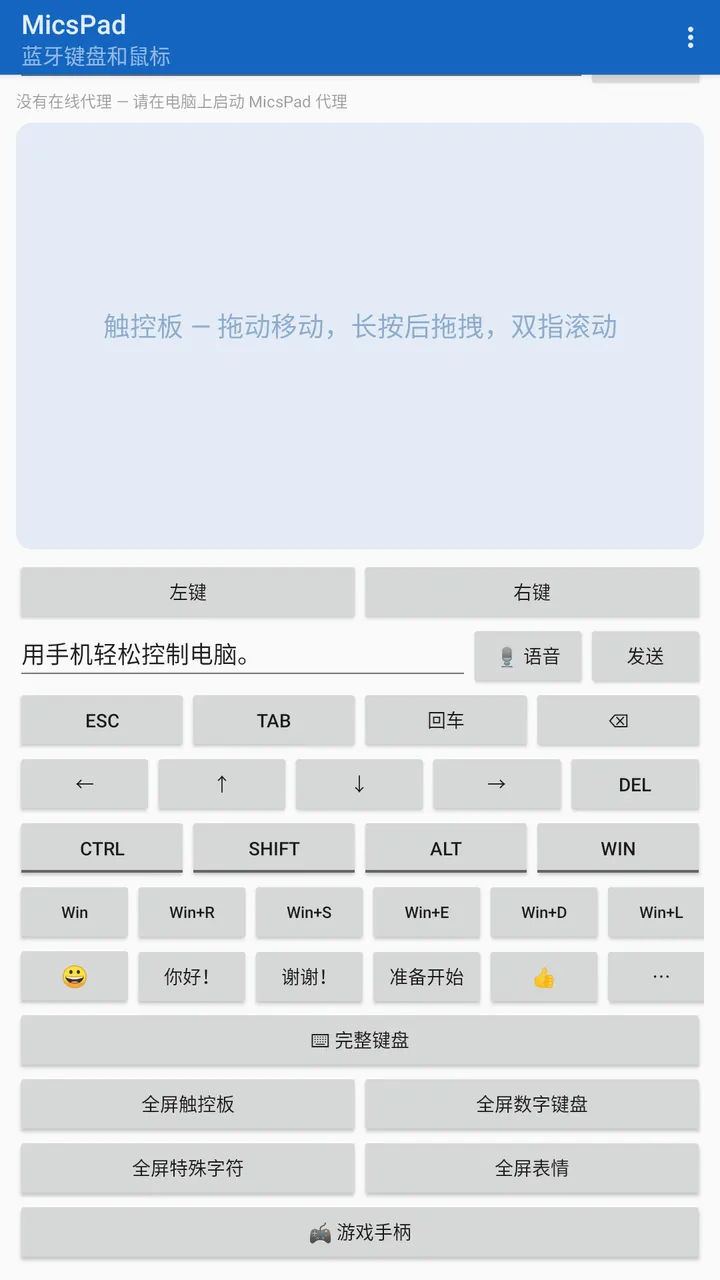
Help: the app's ⋮ → Help opens the User manual. In the Web Remote, use ⋮ → Help / user manual, or the Install it on your computer → link under the room key. ⋮ → About shows the version (app) or the licence (web). MicsPad is © 2026 micstec.com and released under the MIT License.
Privacy and security
- The Android app collects nothing. It has no analytics, ads, accounts or third-party SDKs. Your remembered computers, quick words and settings stay on the phone.
- Bluetooth mode sends input only to the paired, connected device and does not use the internet. Pair only with devices you own, and remove old pairings.
- Web Remote sends your input over an encrypted connection (HTTPS/WSS) through the relay at micspad.micstec.com. The relay forwards it in real time without storing, logging or inspecting it. It keeps the room key only in memory while you are connected. The web page also loads the micstec.com site statistics script (
sp.micstec.com, aggregate mode). The Android app does not. - The room key is the only lock. Anyone who knows it can control that computer while the helper runs. Use a long, unguessable key, keep it private, stop the helper when you finish, and run the launcher with
--newto replace a key you have shared. - Voice: recognition is done by your phone's or browser's speech service, under that provider's terms. MicsPad does not receive or store audio, and it sends a transcript only when you tap Send.
- Read the full privacy policy.
Troubleshooting
| Problem or message | What to do |
|---|---|
| No agent online — start the MicsPad agent on your computer | Start the helper with exactly the same key, including capitals and dashes. Check that the computer is online. Helpers appear within a few seconds |
| key must be at least 6 characters (web) / Room key must be at least 6 characters (app) | Use a key of 6 or more characters on both the phone and the computer |
| reconnecting… (web) / Reconnecting… (…) (app) | The phone lost the relay. It retries automatically. Check the phone's internet connection |
Helper prints --key is required and must be at least 6 characters |
Start it as micspad_agent --key YOURKEY. Double-clicking the .exe without a key does not work |
Helper prints Could not initialize the input backend |
It is not running in a graphical session. Run it in a terminal on the desktop itself, not over SSH or on a headless server |
| The pointer does not move on Linux | Log out and choose an X11 session, such as GNOME on Xorg or Plasma (X11). Wayland blocks input injection |
| The pointer does not move on macOS | Allow the helper (or Terminal) in Accessibility, then restart the helper |
| Chinese or emoji appear as nothing or as wrong characters | Use Web Remote. On Linux, install xclip or xsel |
| The game pad does nothing over Web Remote | Update the helper to 1.2.0 or newer by running the installer again or using the launcher |
| A game ignores the game pad | Switch between Keys: Arrows and Keys: WASD to match the game's controls, or set the game's keyboard controls to these keys |
| This phone's Bluetooth stack has no HID device role or Registration rejected | The phone cannot act as a Bluetooth keyboard. Use Web Remote mode |
| The computer cannot find MicsPad Keyboard/Mouse | Wait for Registered before tapping Discoverable, then pair within 120 seconds. Or pair from the phone's Bluetooth settings and use Connect |
| The computer says it cannot connect | Remove the pairing on both the computer and the phone, then pair again with MicsPad open and Registered |
| No paired devices. Use Discoverable and pair from the host first. | Nothing is paired yet. Follow Pair for the first time |
| Host unplugged the virtual cable (unpaired) | The computer removed the pairing. Pair again |
| Mute, Vol- or Vol+ do nothing over Bluetooth | Remove the pairing and pair again |
| Wrong symbols appear over Bluetooth | The computer uses a non-US keyboard layout. Switch it to US English, or use Web Remote |
| The connection drops when the phone sleeps or you switch apps | Keep MicsPad open. The screen stays on while connected, and the app reconnects when you return |
The launcher shows codes such as \033[36m\033[1m around the room key |
These are colour codes. The key is the text between them, for example abcd-efgh-jkmn |
| Web: saved quick keys do not appear in the Quick keys list | In the current web version, the emoji grid can push the saved list out of view, although Save, Export and Import still work. Edit and delete quick keys in the Android app, or export, edit the file, clear the site's data and import it again |
Frequently asked questions
Can an iPhone work as a Bluetooth keyboard? No. iOS does not let apps act as a Bluetooth keyboard. iPhone users should use the Web Remote in Safari.
Does the computer need software in Bluetooth mode? No. It sees a standard Bluetooth keyboard and mouse.
Can I use MicsPad on a smart TV? In Bluetooth mode, yes, if the TV accepts Bluetooth keyboards and mice. The helper does not run on TVs.
Is it a real game controller? No. The game pad presses keyboard keys, so games must support keyboard controls.
Does MicsPad cost anything? No. The app, the Web Remote and the helper are free, with no ads or accounts.
Can I run my own relay? The helper and the launcher accept --server, and the web page always connects to the server that delivered it. The Android app always uses micspad.micstec.com.